Best Telescopes Under $300 in 2026: What’s Still Worth Buying
Telescopes can cost a great deal of money, but if you already know you want the best telescope under $300, this article has got you covered.
A lot has changed since we first wrote this guide. Orion Telescopes & Binoculars — the brand behind five of our previous six picks — ceased operations in July 2024, together with Meade. Zhumell, another favorite in this price range, quietly disappeared from US shelves by early 2025. In other words, most of the telescopes reviewers were recommending a few years ago simply can’t be bought new anymore.
So we rebuilt this guide from scratch for 2026. Every telescope below is in production, sold new by US retailers, and — with the honest caveats you’ll find in each review — worth your money.
$300 is still a superb price point for a first serious telescope. It’s too much money to throw away on the wrong scope, though, and the market is thinner than it used to be — so the guesswork matters more than ever. Here’s what we found.
Our Top 4 Best Telescopes Under $300 in 2026
- Sky-Watcher Heritage 130P Tabletop Dobsonian — Best Overall
- Celestron StarSense Explorer LT 114AZ — Best for Absolute Beginners
- Celestron AstroMaster 130EQ Newtonian — Best Equatorial Mount
- Celestron C90 Mak — Best Compact & Travel
Sky-Watcher Heritage 130P Tabletop Dobsonian – Best Overall Telescope Under $300
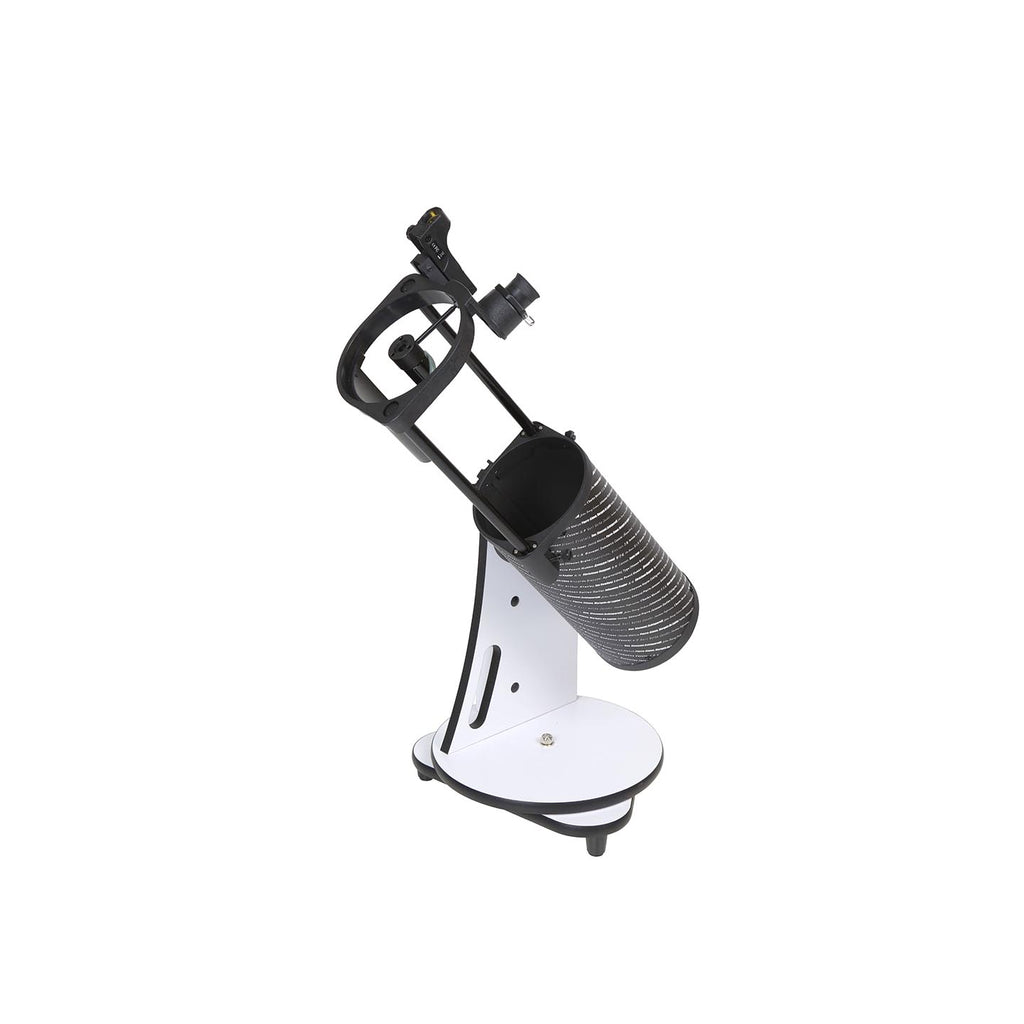
With Orion and Zhumell gone, the Heritage 130P is the last telescope standing in the classic “big aperture, small price” category — and luckily, it’s also the best of them. Sold in the US as the “Heritage 130 Tabletop Dobsonian” (same scope, shorter name), it pairs a genuine 130mm parabolic mirror with a clever collapsible FlexTube design.
A quick note on price: the official list price is $305, so it technically overshoots our budget by the cost of a pizza. Street prices dip under $300 regularly, and even at $305 nothing under this price matches it — which is why it keeps the top spot.
The parabolic mirror is the headline here. At this price most manufacturers cut corners with spherical mirrors, which smear fine detail at high magnification. The Heritage’s 130mm f/5 parabolic optics (650mm focal length) are the real thing, and it shows at the eyepiece.
The collapsible truss tube slides down to about 14.5 inches for storage and extends to 25 inches for observing, holding collimation surprisingly well between sessions. The optical tube alone weighs around 6.5 lbs, so this is a scope you’ll actually take with you.
You get two 1.25″ eyepieces — a 25mm (26x) and a 10mm (65x) — plus a red dot finder. The mount is a simple tabletop Dobsonian: set it on a sturdy table, nudge, observe.
What Can You See?
Jupiter’s cloud belts and its four Galilean moons, Saturn’s rings with the Cassini Division on steady nights, Mars during opposition, and sharp lunar craters. Under darker skies the f/5 optics deliver lovely wide-field views of the Orion Nebula, the Andromeda Galaxy, globular clusters and dozens of Messier objects.
The compromises are minor for the money: the helical focuser feels fiddly compared to a rack-and-pinion, the open tube benefits from a DIY light shroud in the city, and you’ll need a stable table or crate — none is included.
- Genuine parabolic mirror — rare at this price
- Big 130mm aperture
- Collapsible tube, very portable
- Holds collimation well
- Near-zero assembly
- Fiddly helical focuser
- Open tube lets in stray light
- Needs a sturdy table (not included)
- List price is $305 — watch for sales
Celestron StarSense Explorer LT 114AZ – Best Telescope Under $300 for Absolute Beginners
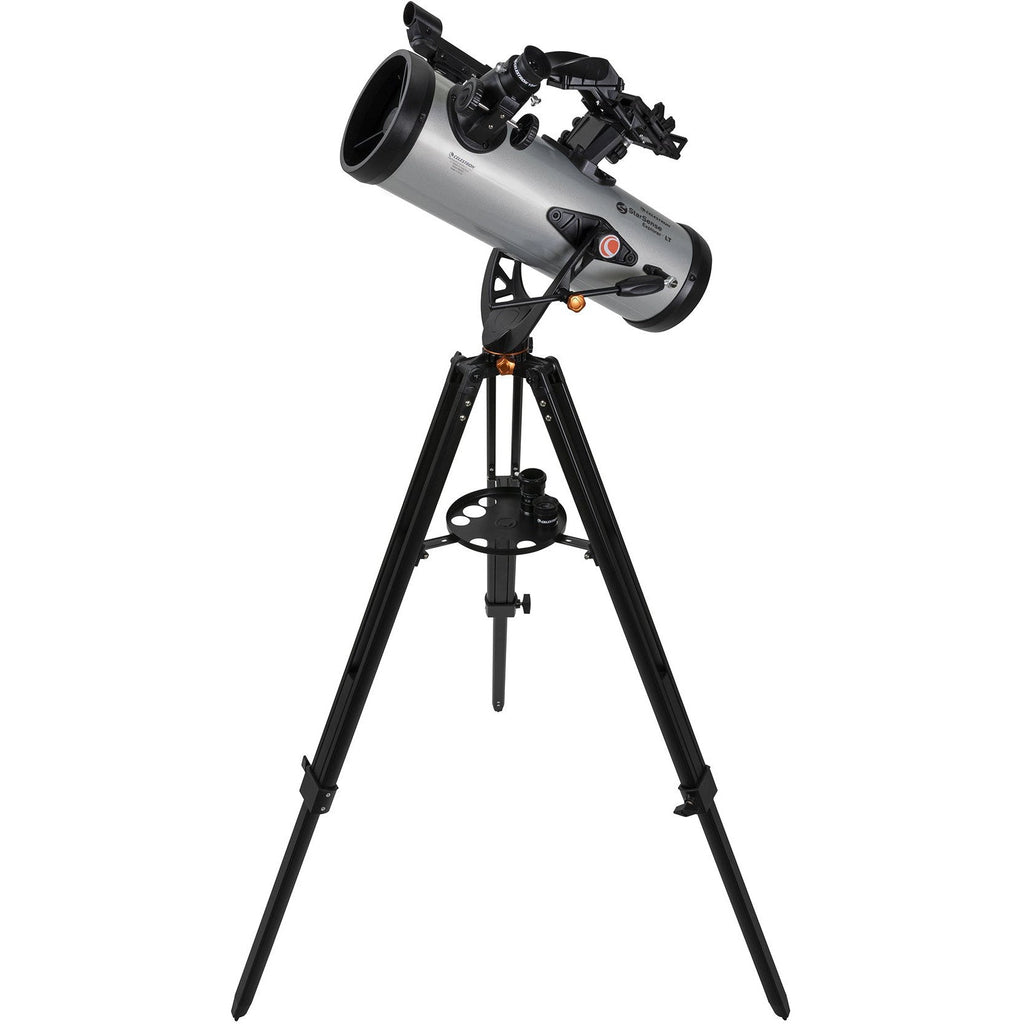
Let’s be upfront about this one: you buy the StarSense Explorer LT 114AZ for the app, not for the optics. If that sounds like faint praise, wait until you’ve tried the app.
The single hardest part of beginner astronomy is finding anything. Celestron’s StarSense Explorer system solves it in a way nothing else at this price does: you dock your phone on the scope, the app photographs the sky and matches the star patterns it sees, then draws arrows on the screen. Push the telescope until the bullseye turns green and your target is in the eyepiece. No alignment ritual, no motors, no batteries beyond your phone.
At around $230-260 (MSRP $259.95), it’s the cheapest ticket into that system, and it comes as a complete kit: 114mm reflector, alt-azimuth mount on a full-height tripod, 25mm and 10mm eyepieces, a 2x Barlow, and a red dot finder — 10.4 lbs all-in.
Now the honest part. Optically this is a Bird-Jones design: a spherical mirror with a corrector lens, squeezing a 1000mm focal length into a short tube. It shows the Moon in fine detail and handles Jupiter’s moons, Saturn’s rings and Venus’s phases well enough, but images soften above roughly 100x magnification and deep-sky objects stay dim at f/9. Independent reviewers are split for exactly this reason — unanimous praise for the app, shrugs for the optics.
Our take: for a family that wants to actually find things on the first night out, this is still the easiest recommendation on the list. If you’d rather put every dollar into glass, get the Heritage 130P above and learn the sky the classic way.
- StarSense app is genuinely brilliant
- Complete kit with tripod and Barlow
- Light (10.4 lbs) and quick to set up
- Well under budget
- Bird-Jones optics — soft above ~100x
- Dim deep-sky views at f/9
- Tricky to collimate
- Lightweight mount wobbles
Celestron AstroMaster 130EQ Newtonian – Best Equatorial Mount Telescope Under $300

The AstroMaster 130EQ is the only telescope from the original version of this guide that’s still in production, and it remains the cheapest way to get a 130mm reflector on a proper German equatorial mount. It needs two caveats in 2026, though.
First, the price. Celestron has raised the MSRP to $359.95, which would knock it off this list entirely — but actual street prices at Amazon and other dealers still hover around $250-290, and Celestron’s own factory-refurbished units go for about $265. Under $300 in practice; just don’t pay list.
Second, the mirror. Recent production has been inconsistent: some units ship with a proper parabolic mirror, others with a cheaper spherical one, and you won’t know which you got until you push the magnification on a planet. At f/5 the difference is real — a spherical sample stays usable for wide-field viewing but goes fuzzy at high power. It’s a lottery we have to mention.
Why keep it on the list at all? Because nothing else under $300 offers this combination: 130mm of aperture, 650mm f/5 optics, and a CG-3 equatorial mount with slow-motion controls that tracks objects with a turn of one knob. If you want to learn how “real” astronomy mounts work — or you plan to add a motor drive later — this is the affordable way in.
It comes with a 20mm erect-image eyepiece (33x) and a 10mm (65x), plus a red dot finder; the whole rig weighs about 17 lbs assembled. The 20mm is a terrestrial design that does the optics no favors — budget $30 for a 25mm Plossl and the scope improves noticeably.
What Can You See?
Lunar craters in detail, Jupiter with its moons, Saturn’s rings, and — thanks to the fast f/5 optics — bright deep-sky showpieces like the Orion Nebula, the Andromeda Galaxy and the Hercules Cluster.
- Real equatorial mount with slow-motion tracking
- 130mm aperture, fast f/5 optics
- Street price well under $300
- Motor drive can be added later
- Mirror quality varies unit to unit
- Poor 20mm stock eyepiece — plan to replace
- EQ mount has a learning curve
- MSRP now over budget — buy at street price
Celestron C90 Mak – Best Compact Telescope Under $300
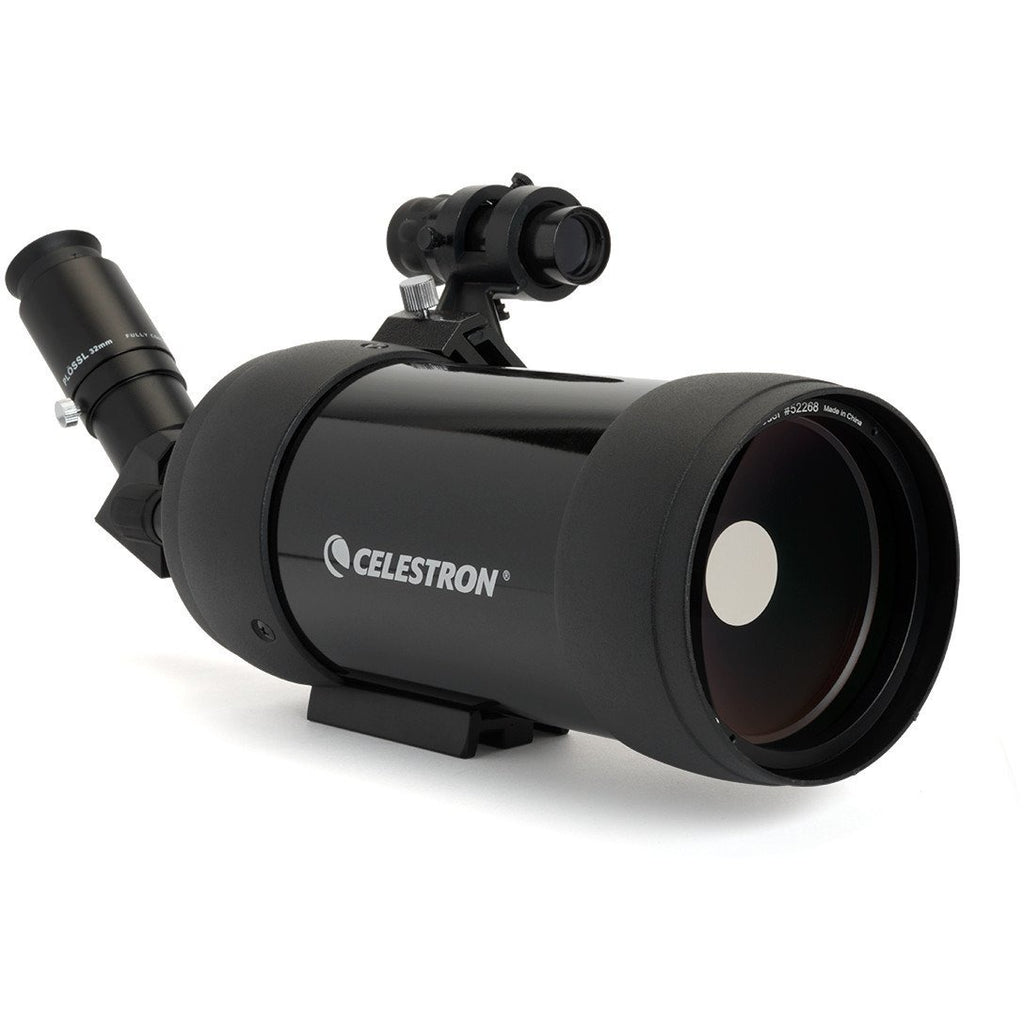
Our old compact pick, Orion’s StarMax 90, is gone with the company — but its replacement is arguably better. The Celestron C90 is a 90mm Maksutov-Cassegrain that folds a 1250mm focal length into an 11-inch tube weighing 4.6 lbs. It fits in the included backpack, and the whole thing qualifies as airline carry-on.
At around $250-280, the C90 is the sharpest optic on this list for the Moon, planets and double stars. Maksutovs never need collimation — a genuine perk for anyone who’d rather observe than tinker — and the long f/13.9 focal ratio delivers the high-contrast, high-magnification views this design is famous for.
It’s also secretly two products in one. With the included 45° erect-image diagonal and 8×21 finder, the C90 doubles as an excellent spotting scope for birding and wildlife — right-side-up images, 15-foot close focus. For astronomy, swap in a 90° star diagonal (about $30-40) to save your neck at the eyepiece; the stock 32mm Plossl gives a comfortable 39x.
The one thing to know before ordering: there’s no mount in the box. The C90 attaches to any sturdy photo tripod you may already own. If you don’t, budget $40-80 for one — the combined price still lands under $350.
What it isn’t: a wide-field instrument. The narrow field of view makes it the wrong tool for sweeping star fields or large nebulae — that’s Heritage 130P territory. For crisp planetary views from a scope that lives in a backpack, nothing under $300 comes close.
- Sharp, high-contrast lunar and planetary views
- Ultra-portable — backpack included
- Never needs collimation
- Doubles as a spotting scope
- No tripod included
- Narrow field of view — not for deep sky
- 45° diagonal is mediocre for astronomy
Worth Stretching the Budget? Three Picks Just Over $300
The under-$300 market shrank when Orion and Zhumell left it, and some of the best value in 2026 now sits just above the line. If you can stretch, these three are worth knowing about:
- Sky-Watcher Heritage 150P (~$355) — the Heritage 130P’s bigger brother. Same collapsible design, 150mm of aperture. The best pure value in beginner telescopes right now.
- Celestron StarSense Explorer 114mm Tabletop Dobsonian ($379.95) — the StarSense app bolted onto a proper 114mm parabolic tabletop Dob. The scope the LT 114AZ should have been. Check it on Amazon — and don’t confuse it with the LT 114AZ above; Amazon’s listing title calls it “114AZ” too.
- Sky-Watcher Skymax 102 (~$355, tube only) — a 102mm Maksutov, the step up from the C90 for dedicated planet watchers.
What Happened to Our Previous Picks?
Earlier versions of this guide recommended the Orion SkyQuest XT6 Plus, SpaceProbe 130ST, AstroView 90mm, StarBlast 4.5 and StarMax 90mm. Orion Telescopes & Binoculars ceased operations on July 9, 2024, and its assets were auctioned off in January 2025. None of these telescopes are manufactured or under warranty anymore.
You’ll still find them on eBay and Amazon marketplace as used or leftover stock — sometimes at silly prices. A used StarBlast at a fair price is still a fine telescope, but there’s no warranty behind it, so buy accordingly. The same goes for Zhumell’s Z114 and Z130, discontinued in 2024-2025: excellent scopes secondhand, no longer a retail option.
Conclusion
The under-$300 telescope market of 2026 is smaller than it was, but the good news is that every scope that survived earns its place:
- Want the most telescope for the money? Sky-Watcher Heritage 130P.
- Want to find objects on night one, zero learning curve? StarSense Explorer LT 114AZ.
- Want to learn a real equatorial mount? AstroMaster 130EQ — at street price, with our eyepiece advice.
- Want sharp planets from a scope that travels? Celestron C90.
When you’re looking for the best telescope, it comes down to choice every time. Decide what you want most — aperture, ease, tracking or portability — because at this price no telescope can be master of everything.